Heavy-Duty Towing in DFW: What Truck, SUV, and Commercial Vehicle Owners Need to Know
You're driving a loaded F-250, a full-size Chevy Suburban, or a commercial sprinter van — and something goes wrong on I-20 or the LBJ Freeway. The engine quits. A tire blows. The transmission locks up. Your first instinct is to call for a tow.
But here's what many drivers don't realize until it's too late: not every tow truck can handle your vehicle. Call the wrong company, and you could be waiting hours for a truck that shows up, takes one look at your rig, and says it can't move it. Or worse — they attempt the tow with underspec equipment and damage your truck in the process.
Heavy-duty towing is a specialized service, and understanding how it works will save you time, money, and frustration the next time something goes sideways on a North Texas road.

What Makes a Vehicle "Heavy-Duty"?
The towing industry divides vehicles into weight classes. Standard light-duty tow trucks — the ones dispatched for most passenger car breakdowns — are rated to handle vehicles up to about 10,000 pounds. That covers the majority of sedans, compact SUVs, and smaller trucks.
But once you're talking about any of the following, you're in heavy-duty territory:
- Full-size pickup trucks like the Ford F-250, F-350, Ram 2500, or Chevy Silverado HD
- Large SUVs like the Chevrolet Suburban, Ford Expedition Max, or Cadillac Escalade ESV
- Diesel trucks with heavy aftermarket modifications or loaded payload beds
- Commercial vehicles — cargo vans, box trucks, delivery vehicles, and work trucks
- Dually trucks (those with dual rear wheels)
- Oversized vehicles with low clearance or unusual configurations
These vehicles have higher gross vehicle weight ratings (GVWR), wider wheelbases, longer overhangs, and in many cases, drivetrain configurations that require specific handling to avoid damage.
The Right Equipment for Heavy Loads
A proper heavy-duty tow requires specialized equipment. Here's what responsible towing companies bring to the job:
Medium-Duty and Heavy-Duty Wreckers
These are larger tow trucks built to handle the extra weight. They have stronger hydraulics, higher-capacity wheel lifts, and reinforced booms. A heavy-duty wrecker can handle vehicles in the 10,000–26,000+ pound range — far beyond what a standard light-duty truck can safely move.
Rotator Wreckers
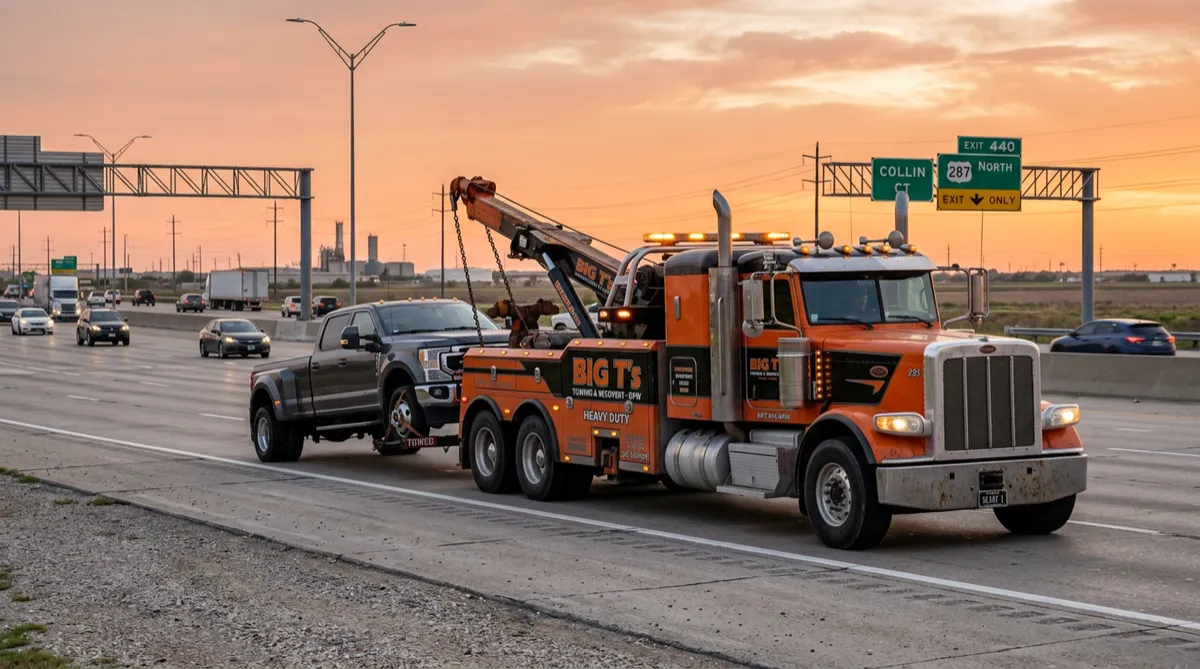
For complex recovery situations — an overturned truck, a vehicle that went off the road into a ditch, or equipment stuck in difficult terrain — a rotator wrecker provides 360-degree rotation to work in tight spaces and at difficult angles. These are the trucks you see at major accident scenes on North Texas freeways.
Flatbed Carriers
For large trucks, luxury SUVs, and commercial vehicles where any wheel contact with the road during transport creates risk, a flatbed is often the safest choice. The entire vehicle rides elevated on the carrier, fully protecting the drivetrain, transmission, and axles from unnecessary wear or damage.
Extended Reach and Custom Rigging
Commercial vehicles with unusual load configurations, box trucks, and specialty equipment often need custom rigging to secure them without damaging the chassis or cargo area during transport.
Why Drivetrain Matters — Especially on HD Trucks
If you drive a diesel HD truck or a large commercial vehicle, the drivetrain is one of your biggest concerns during a tow. Many full-size trucks and commercial vehicles are rear-wheel drive or four-wheel drive. On a rear-wheel-drive vehicle being towed with the rear wheels down, the driveshaft spins even with the engine off — and on some trucks, this can create pressure in the transmission if the vehicle is towed too fast or too far without proper preparation.
The right approach depends entirely on your vehicle:
Rear-Wheel Drive Trucks
Typically towed by the front axle — the rear wheels can roll freely without engaging the drivetrain. On longer distances, a flatbed or a dolly for the rear wheels is the safer option to prevent driveshaft-related wear.
Four-Wheel Drive (4WD) Trucks
If the transfer case can be placed in neutral, the vehicle can be towed on a flatbed or with a wheel-lift — but it's critical that the correct axle is lifted. Many owners don't know their exact drivetrain setup or transfer case configuration, which is another reason why calling a company that specializes in heavy vehicles matters.
Commercial Vans and Box Trucks
These vehicles often have specific tow points and require a tow truck rated for their gross weight. A two-ton commercial van being moved by an underspec light-duty truck is a safety hazard and a liability for everyone on the road.

DFW's Road Network Creates Unique Challenges
The Dallas–Fort Worth Metroplex is one of the busiest freight and commuter corridors in the country. I-20, I-30, I-35, Loop 12, SH-360, and Highway 287 all carry significant heavy truck traffic every day. Breakdowns here are high-stakes — not just because of traffic volume, but because highway shoulders are often narrow, and getting a large vehicle safely off the road requires experience and the right equipment.
Arlington sits at the geographic center of DFW, which means a tow truck based here can reach breakdowns across the metroplex — from Mansfield to Irving, from Grand Prairie to Euless — without the extended response times drivers face when calling a company based on the far side of the metro.
For commercial operators — delivery drivers, contractors, landscaping crews, and HVAC technicians — a breakdown in the middle of a workday costs far more than just the tow bill. Getting the vehicle moved quickly, safely, and to the right repair location is what determines whether the day's schedule is salvageable.
What to Do When a Heavy Vehicle Breaks Down
If you're driving a truck, SUV, or commercial vehicle and something goes wrong, these steps can make a critical difference:
- Get as far off the road as possible. If you can move the vehicle, even a short distance, get it fully onto the shoulder or into a parking lot. A large vehicle partially blocking a lane on I-20 creates a serious hazard for other drivers moving at highway speeds.
- Activate your hazard lights immediately. On a large vehicle that's harder to see around or stop for, other drivers need maximum warning time.
- Use reflective triangles or road flares if you have them. Place them 200–300 feet behind the vehicle, especially at night or in low-visibility conditions. Most commercial operators are required to carry these by law.
- Stay inside the vehicle if you're on a high-speed highway. On an active freeway, remaining inside the cab is significantly safer than standing near the vehicle on the shoulder.
- Call a towing company that specifically handles heavy-duty vehicles. Ask directly: "Can you handle a [year/make/model] that weighs approximately [X] pounds?" If they hesitate or can't give you a clear answer, call someone else.
- Know your tow points. Consult your owner's manual to locate the designated tow points on your vehicle. This helps the operator attach equipment correctly and prevents damage to bumpers, frames, or skid plates.
Commercial Operators: Have a Plan Before You Break Down
If you run a business that depends on vehicles — a plumbing company, a construction crew, or a delivery fleet — a roadside breakdown is an operational emergency. One stalled box truck can throw off a full day's schedule and affect multiple clients.
The most prepared operators keep a trusted heavy-duty tow company's number saved in their phones before they ever need it. They've confirmed in advance whether their vehicles are covered by roadside assistance programs — and they've verified that coverage extends to commercial-use vehicles. Many standard auto policies and roadside plans exclude commercial vehicles or carry lower weight limits than the vehicles they're supposed to cover.
It's also worth knowing your repair shop's address before a breakdown happens, so the tow operator can deliver the vehicle directly without requiring an extra move and additional cost.
Choosing the Right Company for a Heavy-Duty Tow
When a 7,000-pound truck is stranded on a North Texas freeway, the qualifications of the company you call make a real difference. Before the driver arrives, confirm:
- Equipment rating. Can their truck actually handle your vehicle's weight? This is a direct question, and any company worth calling can answer it immediately.
- Experience with your vehicle type. HD diesel trucks, commercial vans, and large SUVs all have different handling requirements. Ask how often they tow vehicles like yours.
- 24/7 availability. A company that's fully staffed around the clock can reach you at 2 AM on a Tuesday just as quickly as at noon on a Saturday. Breakdowns don't follow a schedule.
- Flatbed capability. For certain vehicles — especially those with unique drivetrains or low clearance — a flatbed is the only safe way to transport them. Make sure the company has one available.
When you're dealing with a large, expensive vehicle — one that may represent $50,000 to $100,000 or more of your personal or business investment — the tow is not the place to cut corners on who you call.
If your truck, SUV, or commercial vehicle breaks down in Arlington, Grand Prairie, Mansfield, Irving, Euless, or anywhere across the DFW Metroplex, Roadside Wrangler has the heavy-duty equipment, experienced operators, and 24/7 availability to get you moving again. Based in Arlington at the center of the metro, we reach more of DFW faster than companies operating from the edges of the region. Call us any time — day or night — and tell us what you're driving. We'll send the right truck for the job.
Roadside Wrangler – 24/7 Towing Service | 3004 E Pioneer Pkwy, Arlington, TX 76010 | (469) 212-4712 | https://roadsidewranglertowing.com/ | Open 24 hours.