Lowered or Low-Clearance Car Broke Down in DFW? How to Get It Towed Without Damage
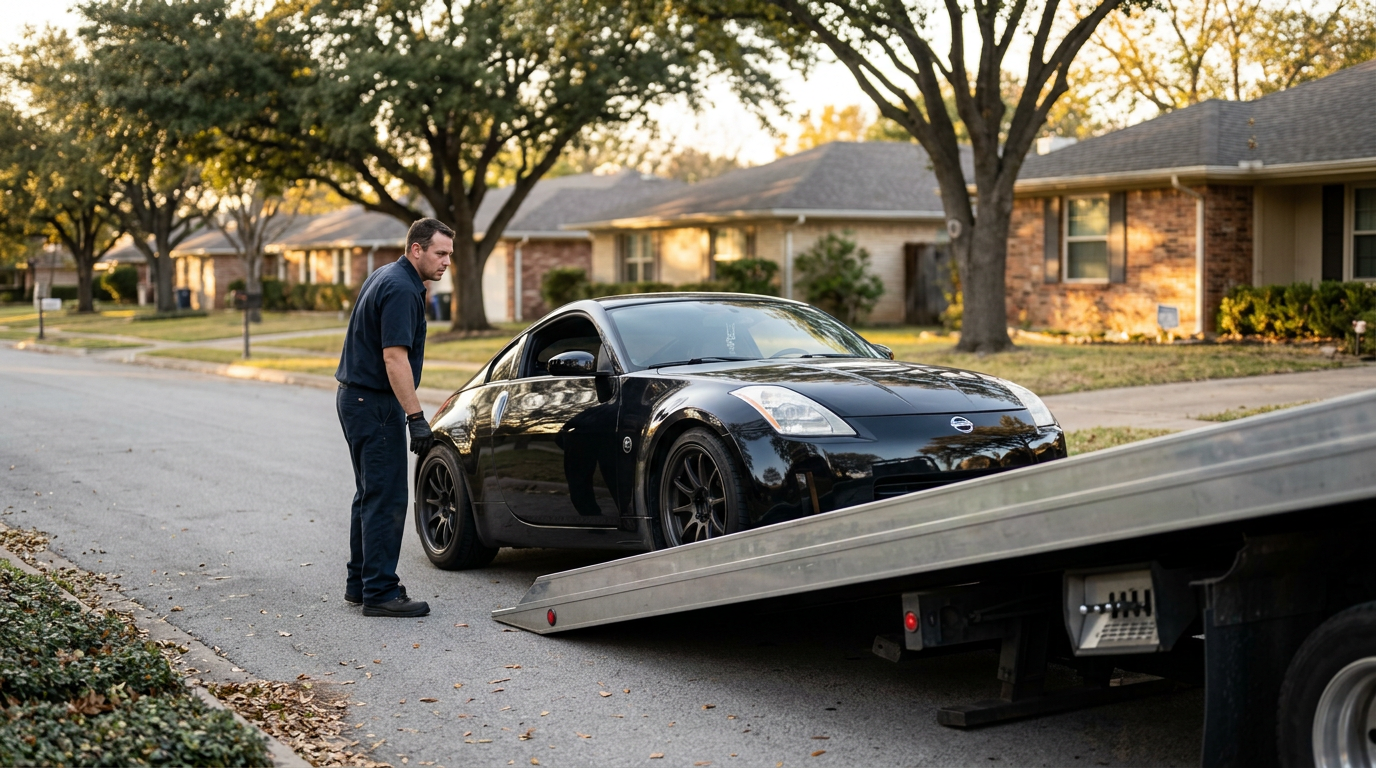
Your lowered car just stopped running, and the tow truck you picture is the one you see hooking up cars on the freeway shoulder. For most vehicles, that works fine. For a car that sits only a few inches off the pavement, the same tow can turn a mechanical problem into a body-shop problem. If you drive a lowered, sports, or other low-clearance car in DFW, the question is simple: how do you get it towed without scraping, cracking, or bending something that was not broken?
The short answer: ask for a flatbed, tell the dispatcher exactly how low the car sits before the truck leaves, and do not let anyone attach chains or hooks to the suspension, bumper, or aftermarket parts. Almost everything below is the reasoning behind those three steps, so you can recognize a safe tow when you see one.
Why a low car is harder to tow than a standard car
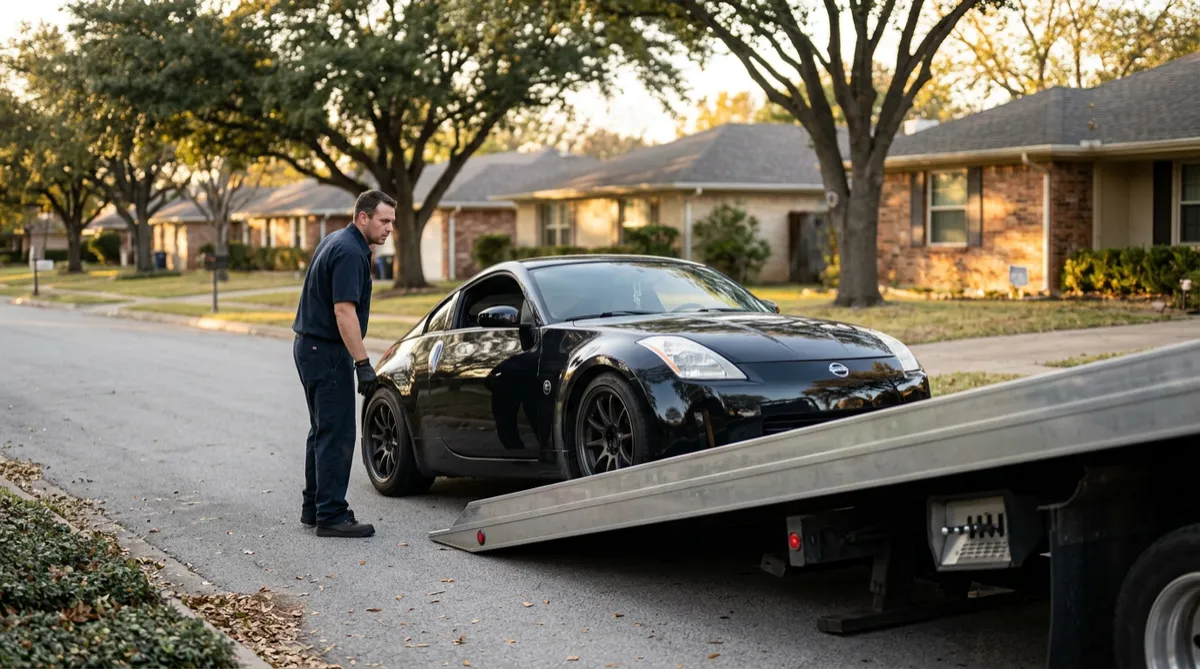
Ground clearance is the whole issue. A typical sedan or SUV has enough room under the front bumper to roll up a standard tow-truck ramp without touching it. A lowered car often does not. The front lip, splitter, side skirts, or exhaust can contact the ramp before the tires do, because the angle between flat pavement and a tilted deck is steep when the car has so little room underneath.
Wheel-lift trucks bring a different problem. A wheel-lift tow cradles the tires at one end of the car and lifts that end off the ground. The lifted end gets plenty of clearance, but the end still rolling on the pavement does not get any extra. On a car that is already low, the rear bumper, rear diffuser, or underbody can drag over a driveway apron, a dip in the road, or a speed hump while the car is being towed. A flatbed removes that risk, because all four wheels sit on the deck and nothing touches the road.
What to tell the dispatcher before the truck leaves
The most useful thing you can do is give the dispatcher details that let the operator plan the load before arriving. A good call covers these points:
- What the car is. Year, make, and model, and whether it has been lowered with springs, coilovers, or air suspension.
- Whether it runs, rolls, steers, and goes into neutral. A car that cannot roll is a different job than one that can, and the operator needs to know before choosing equipment.
- Anything that sticks out low. A front splitter, lip, aftermarket bumper, side skirts, or a low exhaust all change how the car should be loaded.
- Where the car is sitting. A driveway, a garage, a parking lot, a sloped spot, or a tight space that limits how the truck can line up.
- Where it is going. A shop, your home, or a dealership, and whether the destination has a steep driveway apron or a loading area that needs the same care.
If you can do it safely, measure the distance from the ground to the lowest point of the front lip with a tape measure and give the dispatcher that number. A rough figure like "about three inches under the front lip" helps far more than "it's pretty low." Then ask directly whether the operator can handle a low-clearance car and how they plan to deal with the ramp angle. A specific answer is a good sign. A vague "we'll figure it out" is a reason to ask more questions.
How a careful flatbed load works for a lowered car
Most flatbeds used for car towing tilt and slide backward so the end of the deck rests on the ground. That already makes the approach shallower than a fixed ramp would. Operators then have several ways to reduce the angle further when a car is very low:
- Placing planks, blocks, or ramp extenders at the base of the deck so the tires climb gradually and the bumper clears the transition.
- Sometimes loading the car in reverse when the rear overhang is shorter than the front.
- Winching the car up slowly in neutral while a second set of eyes watches the clearance and stops the pull at the first sign of contact.
- Using wheel dollies when the car cannot roll on its own, so the wheels do not have to turn on the deck.
A slow load is a good load. If you hear scraping, the operator should stop, adjust, and try again rather than pushing through. A few extra minutes cost far less than a cracked splitter.
Tie-down points: where the straps go matters
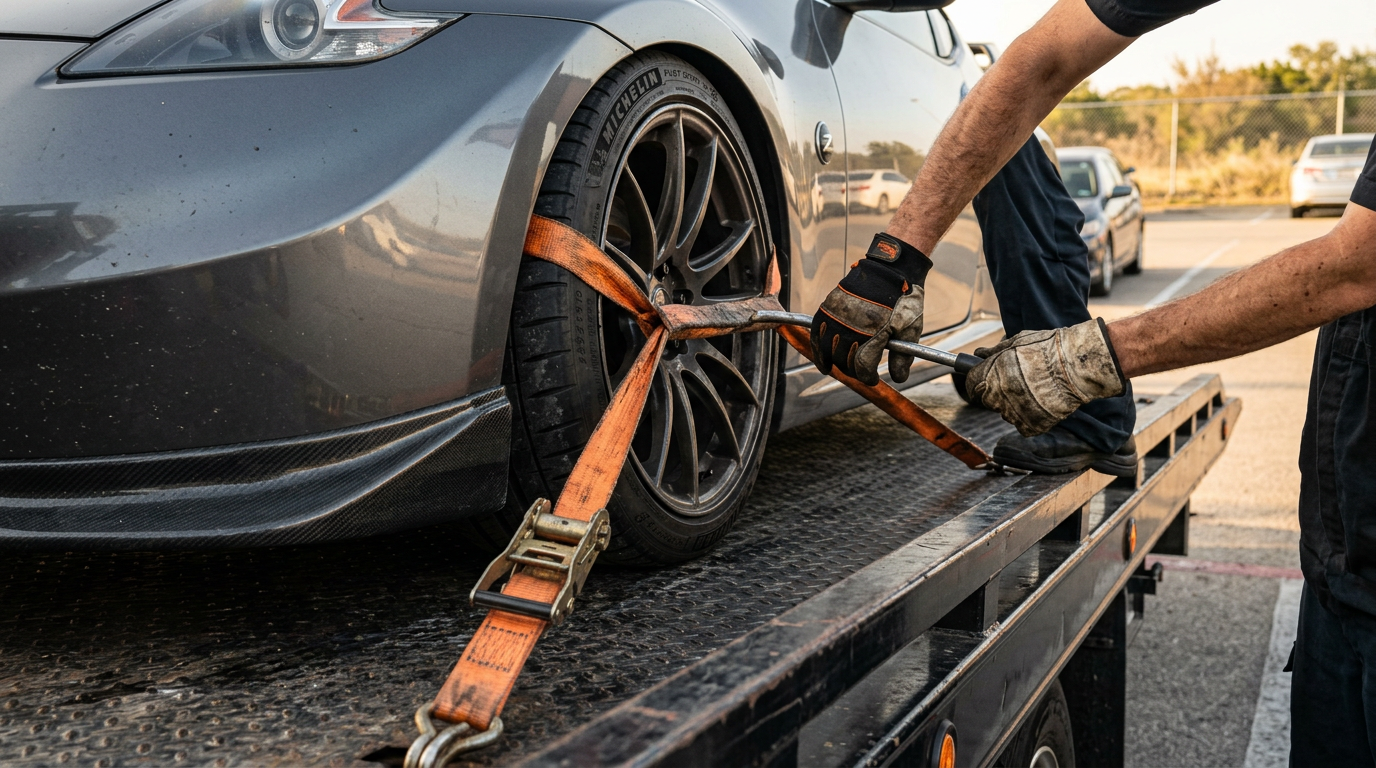
Once the car is on the deck, how it is secured matters just as much as how it was loaded. On a stock car, the manufacturer provides tie-down and tow points. On a modified car, suspension arms, subframes, and aftermarket parts may be adjusted or bolted differently than from the factory. Hooking a chain around a control arm or an aftermarket component can bend or crack it.
The safer approach is a wheel strap system, where straps go over the tires and hold the car by the wheels. The suspension can move normally and no pressure lands on the frame or modified parts. If your car has expensive or polished aftermarket wheels, mention that too, so the operator chooses straps and positions that will not scratch or mark them.
Air suspension and coilovers: tell the operator what is going on
The type of suspension changes the plan, so say which one you have.
Air suspension. A car on air ride can sit extremely low when the system loses pressure or the battery is dead. If the car still has power and the system works, raising it to maximum height before loading can create the clearance the operator needs. If the failure left the car sitting on the ground or on its bump stops, say so, because that completely changes how it has to be approached and loaded.
Coilovers and lowering springs. The ride height on these is set mechanically, so the car will not lift itself for the tow. What you measure is what the operator has to work with. If you recently adjusted the height or have a known tight spot, such as a front lip that scrapes on certain driveways, pass that along as well.
DFW spots that catch low cars
The DFW Metroplex is full of places where a low car's problems start before the tow truck ever arrives. Driveway aprons at homes and apartment complexes often have sharp transitions. Speed humps are common in apartment communities and shopping center lots across Arlington and the surrounding cities. Parking garages can have ramps that change slope abruptly. Construction zones along major freeways leave uneven pavement and patched sections that can catch a low front end.
If your car stalled in a place where the truck cannot line up straight, tell the dispatcher the layout. If it is safe to push the car a short distance to a flatter, more open spot, that may help, but only when you are off the roadway and not in traffic. Never push a car on a freeway shoulder. Turn on your hazard lights, stay clear of traffic, and wait somewhere safe until the truck arrives.
Before you hand over the keys: a quick walkaround
Before the car goes onto the truck, take a few minutes to document its condition. Clear photos protect you if a question comes up later:
- Photograph all four corners of the car, including the front lip, side skirts, rear bumper, and wheels.
- Note existing damage on the paperwork before signing.
- Remove valuables and loose items, and mention any loose or detachable aftermarket parts.
What to avoid
- A wheel-lift hookup without discussing clearance. If the car is very low, ask for a flatbed instead.
- Chains around suspension arms, the subframe, or aftermarket bumpers. Wheel straps are the safer choice for a modified car.
- Forcing a load after you hear scraping. Stop, adjust the angle, and try again.
If your lowered or low-clearance car has quit on you anywhere in Arlington or across the DFW Metroplex, Roadside Wrangler – 24/7 Towing Service answers around the clock. Tell the dispatcher how the car sits, what went wrong, and where you need it to go, so the right truck and loading plan are in place before the driver heads your way. You can call (469) 212-4712 or visit roadsidewranglertowing.com at any hour.
Roadside Wrangler – 24/7 Towing Service
3004 E Pioneer Pkwy, Arlington, TX 76010
Phone: (469) 212-4712
Website: https://roadsidewranglertowing.com/
Open 24 hours