Night Breakdown in DFW: Stay Safe After Dark
Roadside Safety, 24/7 Towing, DFW Metroplex
Night Breakdown in DFW: What to Do When Your Car Breaks Down After Dark
You are on I-30, I-20, Loop 12, or SH-360, it is late, traffic is still moving fast, and suddenly your car loses power. The shoulder looks narrow, the darkness feels heavy, and one question cuts through the fear — what do I do now? This guide walks you, step by step, through exactly how to stay safe, who to call, and how to get reliable nighttime roadside assistance in the DFW Metroplex.
1. The moment your car dies on a DFW highway at night
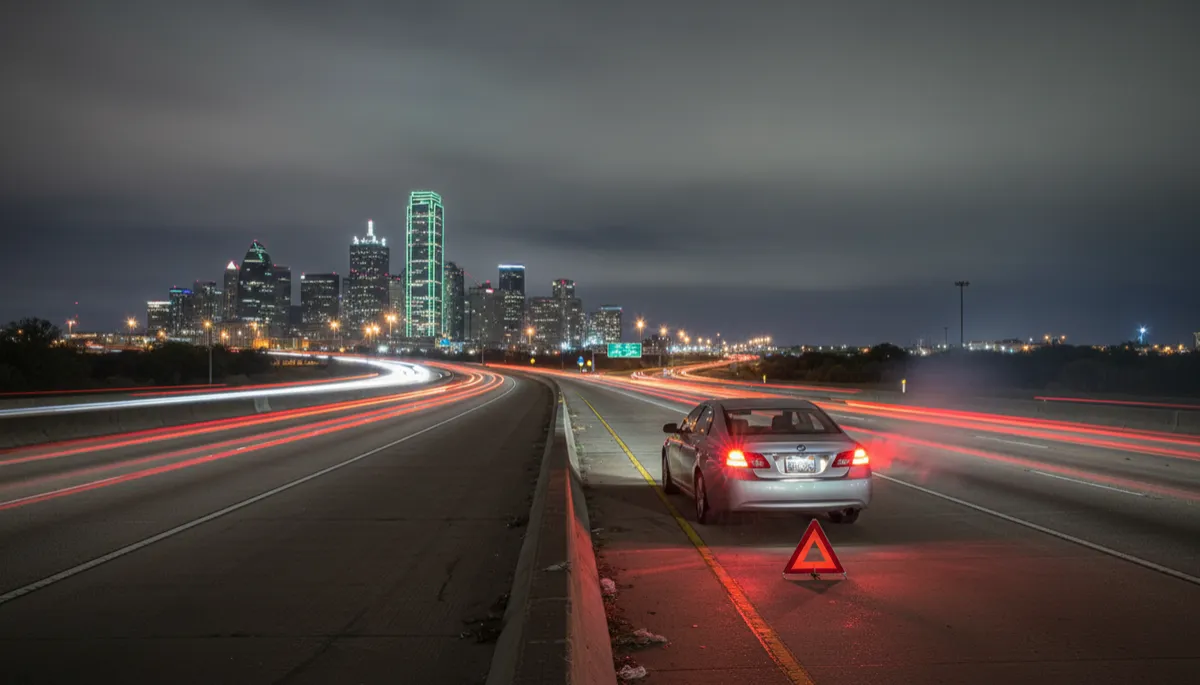
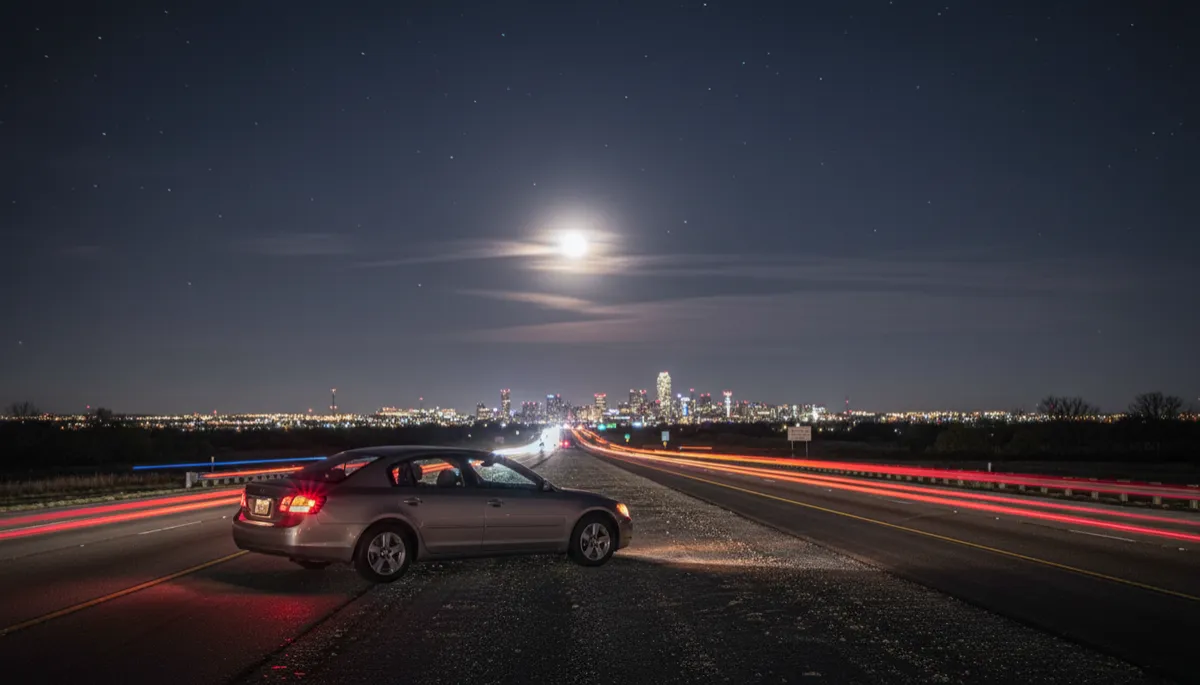
A night breakdown DFW situation rarely gives you much warning. One second you are cruising along I-35W or SH-360, the next your engine sputters, the dash lights up, and you start losing speed. It is quiet inside the car, but outside, vehicles are flying past at 70 miles per hour or more. You may feel a mix of panic and confusion — especially if you are alone, unfamiliar with the area, or already tired from a long day.
In this moment, your first job is not to diagnose the problem, or to worry about repair costs. Your first job is simple and specific — protect yourself from moving traffic and make it easy for help to find you. Every step that follows is built around that one priority.
2. First move: get to safety, off the live lanes
As soon as you feel something is wrong — loss of power, strange noises, heavy vibration — turn on your hazard lights immediately. Do not wait until the car is fully stopped. Those flashing lights buy you precious seconds by warning drivers behind you that something is wrong.
- Steer to the right shoulder if at all possible. On high-speed corridors like I-20, I-30, I-35W, SH-360, and Loop 12, stopping in a live lane at night is extremely dangerous. Use whatever momentum you have left to coast to the right shoulder, a wide exit ramp, or a nearby parking lot.
- Avoid stopping on curves, hills, or narrow bridges. If you can, keep rolling until you reach a straight, visible section of road with a wider shoulder or a lighted area.
If the car dies in a travel lane and will not move, keep your hazards on, stay belted, and call 911 right away. Tell the dispatcher that your car broke down at night DFW and you are blocking a lane — they can alert officers and TxDOT so traffic can be directed around you and a tow truck can be sent quickly.
3. Make yourself and your vehicle visible in the dark
Once you are out of the live lanes, your next priority is visibility. Nighttime crashes often happen because drivers do not see a stopped vehicle, or a person walking near it, until it is too late. You want your car to stand out clearly from as far away as possible.
- Keep your hazard lights on the entire time you are stopped.
- If you have them, place reflective triangles or road flares behind your vehicle — one about 10 feet behind, another 50–100 feet back, angled slightly toward traffic. Only do this if the shoulder is wide enough and you can step out on the passenger side, away from moving vehicles.
- Turn on your interior dome light so responders can easily see that the vehicle is occupied, and can locate you quickly.
If you absolutely must get out — for example, if the vehicle is smoking or you smell fuel — exit on the passenger side, move away from the roadway, and stand behind a guardrail or well up the embankment. Never stand next to your vehicle on the driver’s side, and never stand between your car and traffic. A small tap from a passing car can turn your own vehicle into a deadly hazard.
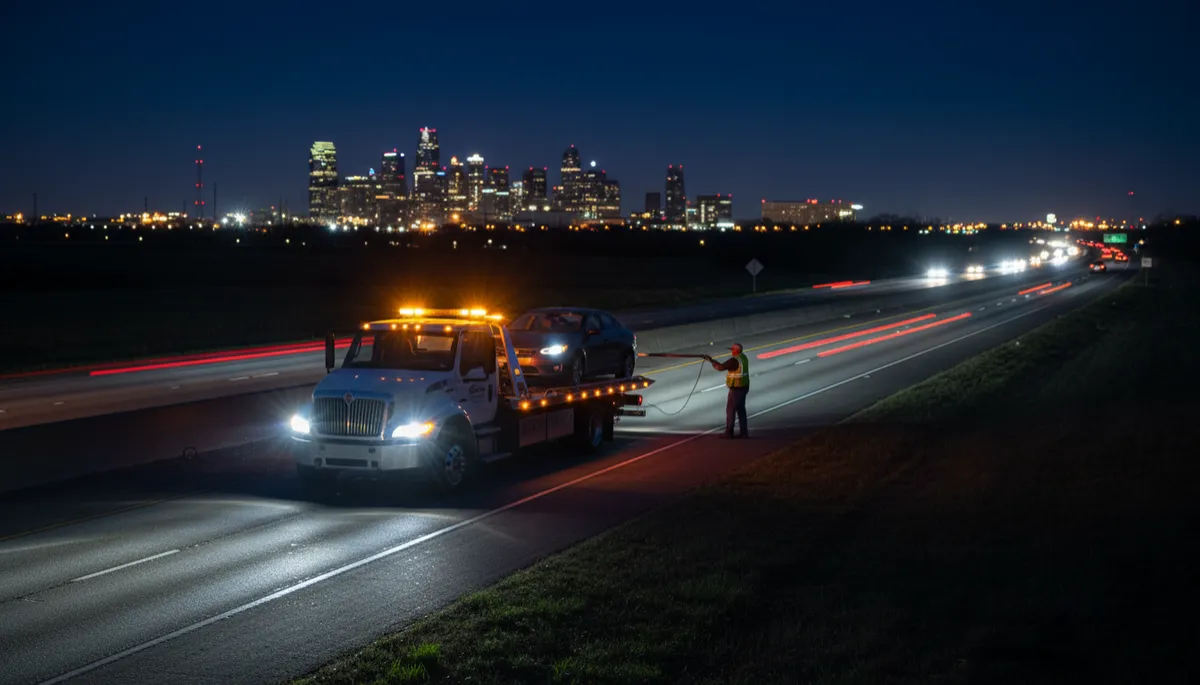
Professional nighttime towing keeps you out of danger in high-speed DFW traffic.
4. Assess the situation without putting yourself at risk
On many major DFW highways, the safest place to be during a breakdown is inside your vehicle, with your seatbelt on and your doors locked. The Texas Department of Public Safety and local providers emphasize staying with your vehicle — especially at night or in bad weather — and avoiding unnecessary time on foot near traffic.
From inside the car, you can quickly run through a mental checklist:
- Are there any immediate dangers — smoke, flames, strong fuel smell? If yes, move away from the vehicle to a safe area and call 911.
- Is the car fully on the shoulder, or are you still partially in a lane? If so, treat this as an emergency and call 911 first, then roadside assistance.
DFW has seen nighttime pedestrian fatalities on its highways, often when people try to walk for help or attempt a DIY tire change in a narrow shoulder. Unless you are in immediate danger inside the car, it is safer to stay put, call for help, and let professionals handle the roadside work.
5. Who to call first for nighttime roadside help in DFW
Once you are stable on the shoulder and there is no immediate fire or medical emergency, it is time to get help headed your way. For many drivers, the first instinct is to call their insurance company’s roadside assistance number. That can work — but it is not always the fastest option when your car broke down at night DFW and you need quick response.
- Insurance or membership roadside assistance (from your insurer, credit card, or auto club) typically routes your call to a national dispatch center. They then contact a local contractor to send a truck. This can add time, especially during busy periods or late at night.
- Calling a local 24/7 towing company directly — such as a tow truck Arlington TX provider — often gets a truck rolling faster, because you are speaking directly to the people who will respond.
For toll roads managed by NTTA, you can also dial #999 from your mobile phone for free roadside assistance, available 24/7. On other major DFW highways, TxDOT’s Safety Patrol or Highway Courtesy Patrol may pass by during peak hours, but they are not guaranteed to operate late at night — so having a reliable emergency towing DFW contact is important.
6. What to tell the tow company so they can find you fast
Clear information saves time — and on a dark shoulder, time equals safety. When you reach a 24/7 towing Arlington TX company or any nighttime roadside assistance DFW provider, be ready with a short, specific description of your situation:
- Your exact location. Give the highway name and direction (for example, “I-30 westbound”), the nearest exit number or street, and any visible landmarks — overpasses, large signs, or nearby businesses. If you have a dropped pin, ask if you can text it to the dispatcher.
- Whether your hazards are on and if you are fully on the shoulder or partly in a lane. This helps the driver plan how to stage the truck safely when they arrive.
- Your vehicle description. Make, model, color, and whether it is a car, SUV, pickup, or motorcycle. Mention if it is loaded with a trailer or has lowered clearance, so the right equipment can be sent.
- What happened. “Engine died and will not restart,” “flat tire on driver’s side,” or “battery completely dead” is enough detail for the dispatcher to decide whether you need a tow, a jump-start, or other roadside help.
The more precise you are, the less time the driver spends searching along the shoulder, and the sooner you are out of harm’s way.
7. Staying safe while you wait for help to arrive
Once a truck is on the way, focus on staying calm and protected. Nighttime breakdowns can feel isolating, but a few simple habits make a real difference in your safety:
- Keep your seatbelt on if you stay in the car. If another vehicle hits yours while you are parked, that belt can prevent serious injury.
- Keep your doors locked and windows up, with the dome light on. This makes you visible but secure.
- Keep your phone battery in mind. Use it mainly for calls with the tow company, 911 if needed, and essential updates — not for streaming or long, nonessential conversations.
If your vehicle is in a particularly exposed spot — such as a narrow shoulder on a curve — do not hesitate to tell the dispatcher this. A professional emergency towing DFW provider understands the urgency and will prioritize hazardous locations when possible.
8. If a stranger stops to “help” at night
Most people who stop are genuinely trying to help — but you are never obligated to open your door or accept assistance from anyone you do not know. Texas DPS advises keeping your doors locked and only cracking the window slightly if you choose to speak with someone who stops.
- You can simply say, “Thank you, help is already on the way,” or ask them to call 911 for you if you do not have service or your phone is dead.
- If you feel uncomfortable, it is okay to tell them clearly to move on, or to call 911 yourself and let the dispatcher know that someone is at your vehicle and you would like an officer to come by.
Your safety comes first. Professional nighttime roadside assistance DFW teams are used to working in the dark, with proper lighting, reflective gear, and training — that is who you want handling the situation.
9. When the tow truck arrives: what to check and confirm
Seeing the tow truck’s lights in your mirror is a relief, but there are a few quick checks that keep everything smooth and professional from here on out — whether you called a tow truck Arlington TX provider or another DFW operator.
- Verify the company name. Make sure the truck’s branding matches the company you called, and confirm the driver’s name if the dispatcher gave you one.
- Confirm the destination and service before the vehicle is hooked up — for example, “We are going to my home in Arlington,” or “We are going to my mechanic near Mansfield.” This avoids confusion or extra mileage later.
- Ask about how your vehicle will be secured. Reputable companies use proper tie-downs, wheel straps, and loading techniques to prevent damage, especially for low-clearance or all-wheel-drive vehicles.
Before the truck pulls away, take a few quick photos of your car’s condition — front, rear, and sides. It is a simple habit that protects everyone and documents the state of the vehicle at pickup.
10. A calm plan for any night breakdown in the DFW Metroplex
A nighttime breakdown on I-20 near Arlington, a dead battery on Loop 12, a flat on SH-360 — none of these moments are pleasant, but they do not have to turn into a crisis. When you remember the core steps — get to safety, make yourself visible, stay in the car if it is safer, call for professional help, and verify details when the truck arrives — you turn a frightening situation into a manageable delay.
If your car breaks down tonight anywhere in Arlington, Grand Prairie, Mansfield, Irving, Fort Worth, or anywhere across the DFW Metroplex, you do not have to handle it alone. Roadside Wrangler provides 24/7 towing Arlington TX drivers can rely on — from light-duty towing and flatbed transport to jump-starts, tire changes, fuel delivery, and winch-outs. When you face a night breakdown DFW situation and need calm, professional support, their responsive team is ready to get you and your vehicle off the shoulder and safely where you need to go.
Roadside Wrangler – 24/7 Towing Service | 3004 E Pioneer Pkwy, Arlington, TX 76010 | (469) 212-4712 | https://roadsidewranglertowing.com/ | Open 24 hours.