Stranded on DFW Toll Roads: What to Do
Towing, Roadside Assistance, DFW Toll Roads
Stranded on a DFW Toll Road: What to Do on the DNT, PGBT, or Sam Rayburn Tollway
If your car suddenly loses power on the Dallas North Tollway or you hear a loud pop on the President George Bush Turnpike, you have only seconds to make the right move. DFW toll roads are fast, crowded, and often have narrow shoulders, so knowing exactly what to do before you ever break down can keep a scary situation from turning into something worse.
Why DFW Toll Road Breakdowns Are So Dangerous and Stressful
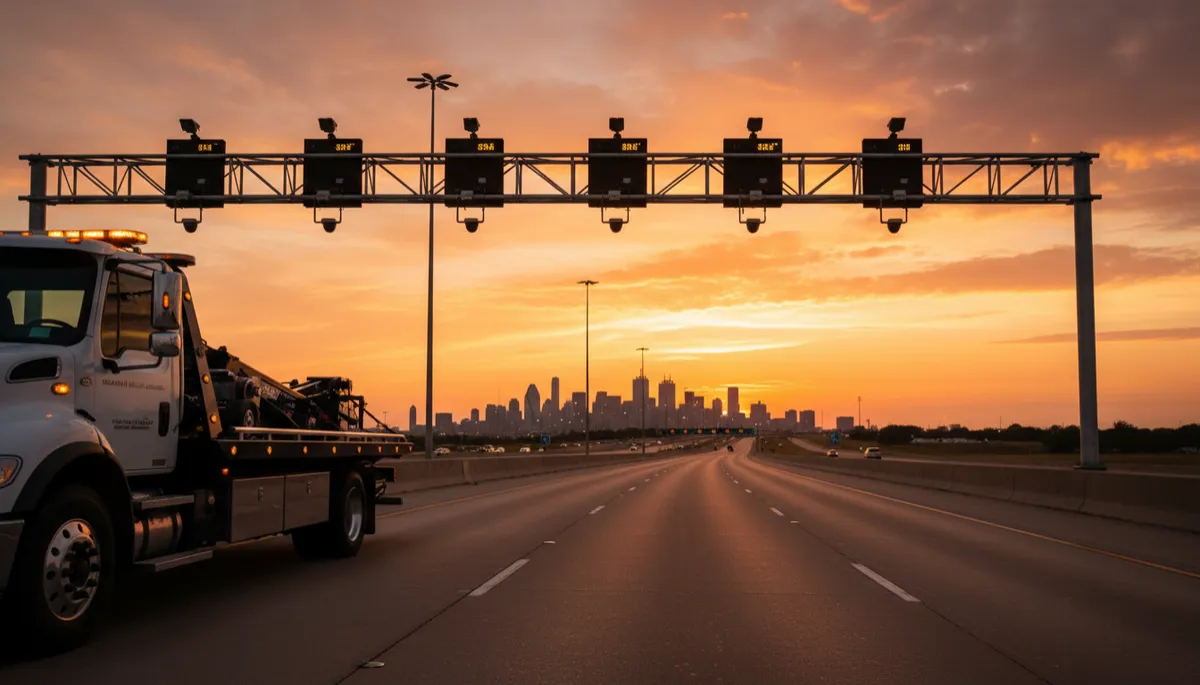
Breaking down on a neighborhood street is frustrating. Breaking down on a high-speed toll road like the Dallas North Tollway (DNT), President George Bush Turnpike (SH 190), or Sam Rayburn Tollway is a different level of risk and stress. Traffic routinely moves at 70+ mph, and many stretches have limited or no full-width shoulders, especially near interchanges, bridges, and construction zones. Electronic toll gantries, curves, and sound walls can also block drivers’ view of a stopped vehicle until they are very close, reducing reaction time and increasing the chance of a secondary crash.
On NTTA-operated roads such as the DNT, President George Bush Turnpike, Lewisville Lake Tollway, Sam Rayburn Tollway, and the Mountain Creek Lake Bridge corridor, traffic is dense almost all day. When your vehicle suddenly loses power, you may have nowhere obvious to go and only a few hundred feet of narrow shoulder before a barrier or bridge. Add the confusion of not knowing whether to call 911, NTTA, your insurance, or a towing company, and it is easy to feel overwhelmed in seconds.
Your #1 Priority: Get to Safety, Then Stay Put if Traffic Is Heavy
The most important thing during any DFW toll road breakdown is simple: protect yourself and your passengers. Everything else—towing, repairs, even the car itself—comes second. As soon as you feel something is wrong (loss of power, loud mechanical noise, flat tire, smoke), do the following if you can do it safely:
- Signal and move right immediately. Turn on your right turn signal and gently steer toward the right shoulder, an emergency pull-off, or the nearest exit ramp. Avoid stopping in a live lane if at all possible, even if you have to drive slowly on a flat tire for a short distance to reach a safer area.
- Turn on your hazard lights. The instant you realize you may need to stop, switch on your flashers. This gives drivers behind you more time to react and is one of the simplest ways to prevent a collision.
- Stop as far from traffic as possible. If there is a grass area or wider paved shoulder beyond the white line, use it. The more space between your vehicle and traffic, the safer you are—especially on curves and near toll gantries where visibility is limited.
Once you are stopped, stay inside the vehicle with your seatbelt on unless there is an immediate danger such as fire or heavy smoke. Texas’ Move Over law requires drivers to slow down or change lanes when approaching stopped vehicles, but not everyone obeys it consistently. On a fast-moving toll road, walking on the shoulder or standing near the lanes is often more dangerous than remaining buckled in your car.
How to Describe Your Exact Location on a Toll Road
On neighborhood streets you can give an address or business name. On the DNT or Sam Rayburn Tollway, there may be no obvious landmarks. Clear, specific location details help NTTA patrols, law enforcement, and towing companies reach you faster and avoid multiple passes up and down the corridor. Use as many of these as you can:
- Overhead gantry or plaza numbers. Many NTTA gantries and tolling points are numbered or labeled. If you can see a sign with a number or name, such as a plaza name, share that with the dispatcher: “I’m just north of gantry 123 on the Dallas North Tollway, right shoulder, southbound.”
- Mile markers and direction. Look for small green mile marker signs along the shoulder. Tell the responder, “Sam Rayburn Tollway, eastbound, around mile marker 42.”
- Nearby cross streets or exits. If you can see an exit sign or cross street—like “near the Plano Parkway exit” or “between Frankford and Trinity Mills”—include that information. It narrows your location quickly on long stretches like the President George Bush Turnpike.
- The toll road app. NTTA’s TollMate app includes a Free Roadside Help option that can transmit your location to their dispatch when you request assistance, which can be especially helpful at night or in low-visibility areas.
When you call a towing company for towing DFW toll road service, using this same language—road name, direction, nearest exit or gantry, and whether you are on the right shoulder, left shoulder, or an exit ramp—helps them plan the safest approach and avoid missing you in fast-moving traffic.
NTTA Roving Safety Patrol: What They Can and Cannot Do
The North Texas Tollway Authority (NTTA) operates a free Roadside Safety Services patrol on its roads, including the Dallas North Tollway, President George Bush Turnpike, Sam Rayburn Tollway, Lewisville Lake Tollway, and Mountain Creek Lake Bridge corridor. According to NTTA, you can dial #999 from your mobile phone or use the TollMate app’s roadside help feature to request assistance on NTTA-operated toll roads and TEXpress lanes they serve (ntta.org).
These roving trucks are on the toll roads 24/7 and can:
- Change a flat tire or install your spare
- Provide a jump-start for a dead battery
- Deliver a small amount of fuel to get you to the next exit
- Help push or move your vehicle to a safer spot and provide traffic protection with lights and cones
However, it is important to understand their limits: NTTA safety patrols do not provide towing. If your car has a major mechanical failure, transmission problem, severe overheat, or collision damage, they can help make the scene safer and may assist with basic troubleshooting, but you will still need a professional towing company to remove the vehicle from the toll road.
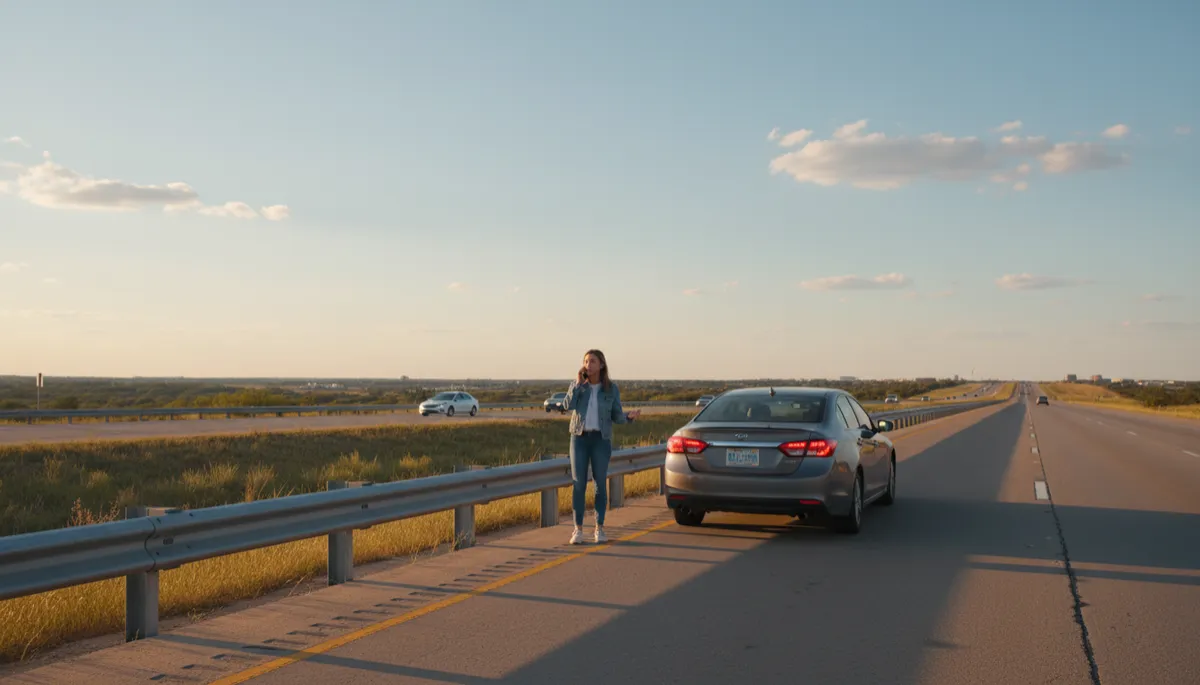
Staying behind the guardrail while you call for help greatly reduces your risk.
When to Call a Professional Towing Company
Once you are safely on the shoulder and have contacted NTTA (if you are on one of their roads), the next question is whether you need a tow. You should arrange professional towing on a DFW toll road when:
- The vehicle cannot move under its own power. If the engine will not start, the transmission will not engage, or the car stalls repeatedly, staying on the toll road is not safe, even if you are partially on a shoulder.
- NTTA patrol cannot fix the problem. If the safety patrol has already tried a jump-start, tire change, or fuel top-up and the vehicle still will not operate safely, it needs to be towed off the tollway.
- Your vehicle requires flatbed transport. Many all-wheel-drive, luxury, or low-clearance vehicles should not be towed with traditional wheel-lift methods. A flatbed tow truck protects these vehicles from driveline damage and underbody scraping, especially when entering or exiting steep ramps along the DNT and Sam Rayburn Tollway.
On busy corridors like the Dallas North Tollway, President George Bush Turnpike, and Sam Rayburn Tollway, having a tow truck dispatched quickly can also reduce the risk of secondary crashes and help traffic return to normal sooner. A dedicated 24/7 towing DFW provider familiar with toll road procedures will coordinate with law enforcement and NTTA when necessary to approach your vehicle safely.
What Not to Do During a Toll Road Breakdown
In a frightening situation, it is easy to make a rushed decision that increases your risk. During a DNT breakdown or a stall on the Lewisville Lake Tollway or Mountain Creek Lake Bridge, avoid the following:
- Do not walk along the toll road or across lanes. Even if the next exit “looks close,” traffic speeds and blind curves make walking extremely dangerous. Wait for professional help unless staying in the vehicle is clearly unsafe due to fire or similar danger.
- Do not stand between lanes or behind your vehicle. If another driver drifts onto the shoulder, you have almost no time to react. If you exit, move away from the road and behind a barrier or guardrail when possible.
- Do not leave the car running in a closed space. In rare cases, if you end up stopped inside a tunnel-like underpass or enclosed area, idling for long periods can create exhaust buildup. If you smell heavy fumes and it is safe to do so, turn the engine off and crack a window slightly while you wait for help.
- Do not forget your hazard lights. Leaving a dark, unlit car on the shoulder—especially at night or in rain—makes it much harder for other drivers to see you in time. Keep your flashers on until help arrives or you are safely off the road.
Why a Local, Licensed Towing Company Matters on DFW Toll Roads
When you search your phone for “tow truck near me,” you may see a long list of results—some local, some not, and some that are simply call centers reselling your job. On DFW toll roads, choosing a local, licensed towing company is more than a convenience; it is protection against confusion, delays, and potential predatory behavior.
- Knowledge of toll road rules. Local operators who regularly work on the Dallas North Tollway, President George Bush Turnpike, Sam Rayburn Tollway, and other NTTA facilities understand how to coordinate with safety patrols and law enforcement, where to stage their trucks, and how to load vehicles quickly without creating additional hazards.
- Clear identification and paperwork. Licensed towing companies operate marked trucks, provide written or electronic paperwork, and are accountable to local regulations. This reduces the risk of surprise fees, unauthorized tows, or difficulty locating your vehicle later.
- Faster, more accurate response. A towing provider based in the Metroplex is more likely to know exactly where you are when you say “northbound DNT just past Spring Creek” or “on the Mountain Creek Lake Bridge corridor, westbound.” That familiarity cuts down on missed exits and wasted time when every minute on the shoulder feels long.
By contrast, some random listings or lead services may dispatch a truck from far outside the area or send an operator unfamiliar with toll road procedures. In a high-risk environment like a DFW toll road breakdown, that is not a chance most drivers want to take.
How Roadside Wrangler Helps DFW Drivers on Toll Roads 24/7
Roadside Wrangler is a local towing and roadside assistance provider based in Arlington and serving the entire DFW Metroplex around the clock. That includes rapid response for breakdowns on the Dallas North Tollway, President George Bush Turnpike, Sam Rayburn Tollway, Lewisville Lake Tollway, and the Mountain Creek Lake Bridge corridor, as well as other major highways and surface streets across North Texas.
When you call Roadside Wrangler from a toll road, you are connected to a team that understands local traffic patterns, common breakdown spots, and how to work alongside NTTA’s Roadside Safety Services and law enforcement. Their flatbed and wheel-lift trucks are equipped to handle passenger cars, SUVs, light trucks, and many specialty vehicles that require careful loading and transport off elevated sections and tight shoulders.
Whether you are an Arlington commuter stuck on the President George Bush Turnpike, a family visiting Frisco stranded on the DNT, or a contractor whose work truck has quit on Sam Rayburn Tollway, having a 24/7 towing DFW partner you can reach any time of day or night removes one major worry from an already stressful situation.
A Clear Plan for Any DFW Toll Road Breakdown
The next time you drive the Dallas North Tollway, President George Bush Turnpike, Sam Rayburn Tollway, Lewisville Lake Tollway, or the Mountain Creek Lake Bridge corridor, you do not have to wonder what you would do if your car suddenly failed. The plan is straightforward: move to the right shoulder or an emergency pull-off if you can, turn on your hazard lights, stay in the vehicle if traffic is heavy, and clearly describe your location using gantry numbers, mile markers, and exit names. Call #999 on NTTA roads for free safety patrol help, and when your vehicle cannot be made roadworthy on the spot, contact a trusted local towing company that knows DFW toll roads and can reach you quickly.
Roadside Wrangler serves Arlington and the wider Metroplex with 24/7 towing and roadside assistance, so whether you are dealing with a dead battery at the gantry, a blown tire near a bridge, or a complete mechanical failure in the middle of a weekend trip, you have a reliable option to get you and your vehicle safely off the toll road and on to your next step. Having that number saved in your phone before you need it can turn a stressful breakdown into a manageable delay instead of a crisis.
Roadside Wrangler – 24/7 Towing Service | 3004 E Pioneer Pkwy, Arlington, TX 76010 | (469) 212-4712 | https://roadsidewranglertowing.com/ | Open 24 hours.