Texas Move Over Law: What DFW Drivers Need to Know When Passing a Tow Truck
Texas Move Over Law, Tow Truck Safety, Highway Safety DFW, Arlington TX Towing
The Texas Move Over Law: What DFW Drivers Need to Know When Passing a Tow Truck
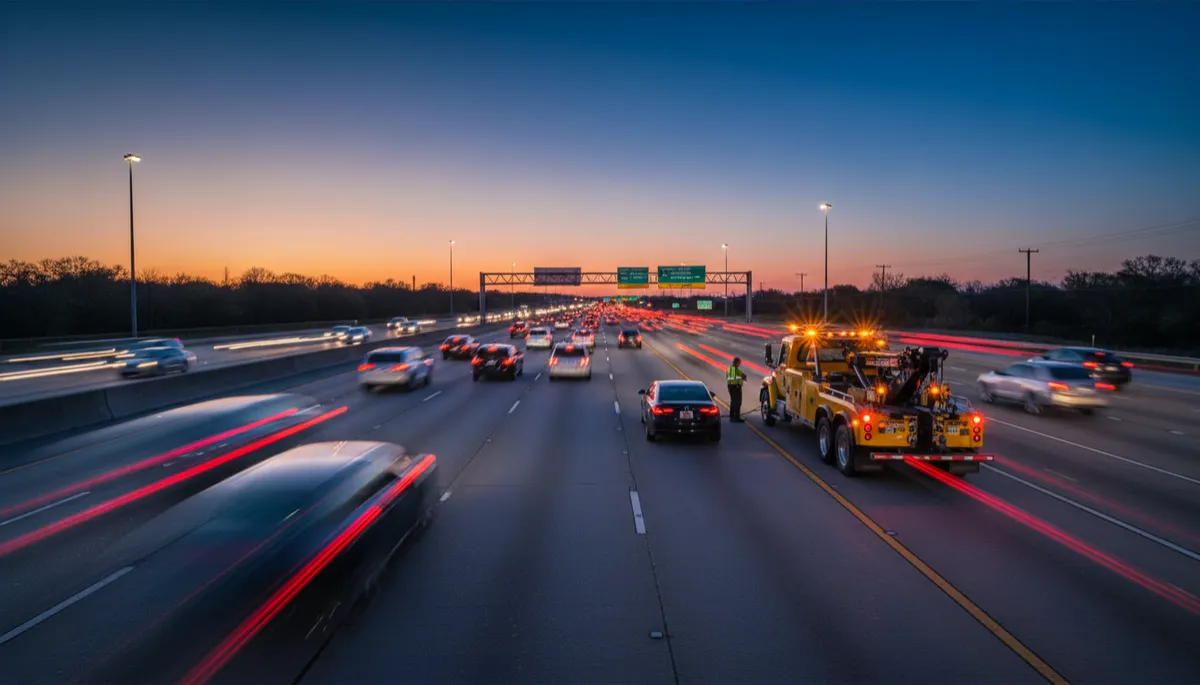
You are cruising along I-30 or I-20 through Arlington, traffic finally flowing after a slowdown, when you see it: flashing amber lights up ahead on the shoulder. A tow truck is angled behind a disabled car, a driver standing just a few feet from 70‑mph traffic. You have a couple of seconds to decide what to do — and whatever you choose will either protect them or put them at serious risk, legally and physically.
The Direct Answer: What the Texas Move Over Law Requires
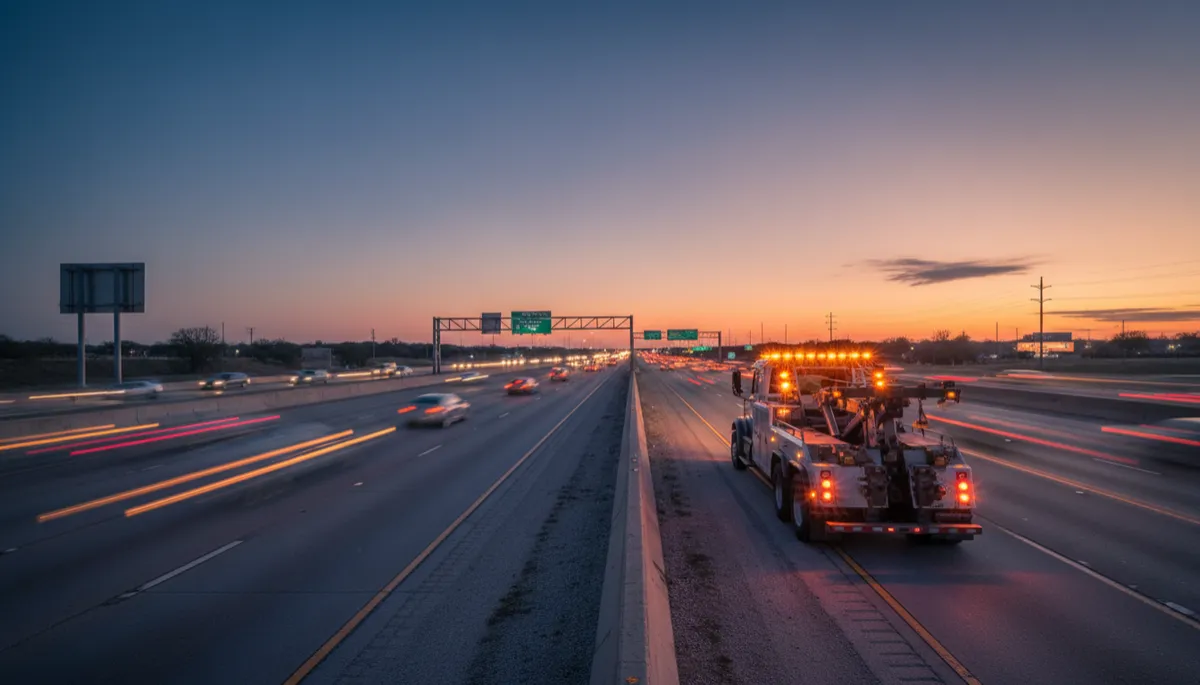
Texas Transportation Code §545.157, often called the Texas Move Over Law or Move Over Act Texas, gives you a clear rule when you approach a tow truck or other authorized vehicle with flashing lights on the roadside:
- If you can safely change lanes: Move over at least one lane away from the stopped vehicle.
- If you cannot safely change lanes: Slow down to 20 mph below the posted speed limit. If the posted limit is 25 mph or less, you must slow to 5 mph.
That is it. No guesswork, no gray area. On a 70‑mph stretch of I‑20, if you cannot move over, you should be passing that tow truck at about 50 mph — not 70. This isn’t just a safety suggestion; it is a legal requirement designed to protect everyone involved in a roadside emergency DFW situation.
Who the Texas Move Over Law Covers Today
When this law first rolled out, many drivers thought it only applied to police cars. As of 2026, the scope is much broader. According to TxDOT and the current text of §545.157 (txdot.gov, Texas statutes), you must move over or slow down for all of the following when they are stopped on or near the roadway with proper flashing lights activated:
- Police vehicles and other law enforcement
- EMS and ambulances
- Fire trucks and other fire department vehicles
- Tow trucks and roadside assistance vehicles, including those providing DFW towing and Arlington TX towing services
- TxDOT vehicles and highway maintenance or construction trucks
- Utility service vehicles (electric, water, telecom, etc.) with proper warning lights
- Vehicles operated under towing and booting permits (Occupations Code Chapter 2308)
- Animal control officers and parking enforcement vehicles (added in 2025)
In practice, if you see flashing lights on the shoulder in Texas — red, blue, or amber — assume the Move Over Law applies and act accordingly.
Penalties for Ignoring the Move Over Law in Texas
The penalties have become more serious over time. As of 2026, under Texas Transportation Code §545.157 and related updates (TxDOT, Texas statutes):
- First offense: Misdemeanor with a fine of up to $1,250.
- Second or subsequent offense within five years: Fine between $1,000 and $2,000.
- If your violation causes bodily injury: It can be charged as a Class A misdemeanor, with possible jail time and fines up to $4,000.
- Repeat violation causing injury: Can be prosecuted as a state jail felony, with much more severe consequences.
Courts can also suspend your driver’s license for repeat offenses and may order community service in addition to or in place of part of the fine. DPS regularly runs enforcement campaigns — especially around major holidays — and reports thousands of Move Over Law citations each year across the state.
Why This Matters Even More on DFW Highways
The Metroplex is not a sleepy rural area. Corridors like I‑20, I‑30, I‑35W, I‑635, Loop 12, and SH‑360 carry a mix of heavy commercial trucks, commuters, and local traffic, often at 65–75 mph or more. Lanes are packed, shoulders can be narrow, and sight lines are often limited by curves, overpasses, and congestion. From a highway safety standpoint, highway safety DFW is about margin — the small amount of space and time that keeps a near miss from becoming a fatal crash.
When you move over early for a tow truck or slow down as required, you give the operator and the stranded driver a buffer. On a busy DFW interstate, that buffer is the difference between a safe recovery and a chain‑reaction collision. Many Arlington TX drivers underestimate just how exposed a person is when standing a few feet off the fog line with their back to traffic.
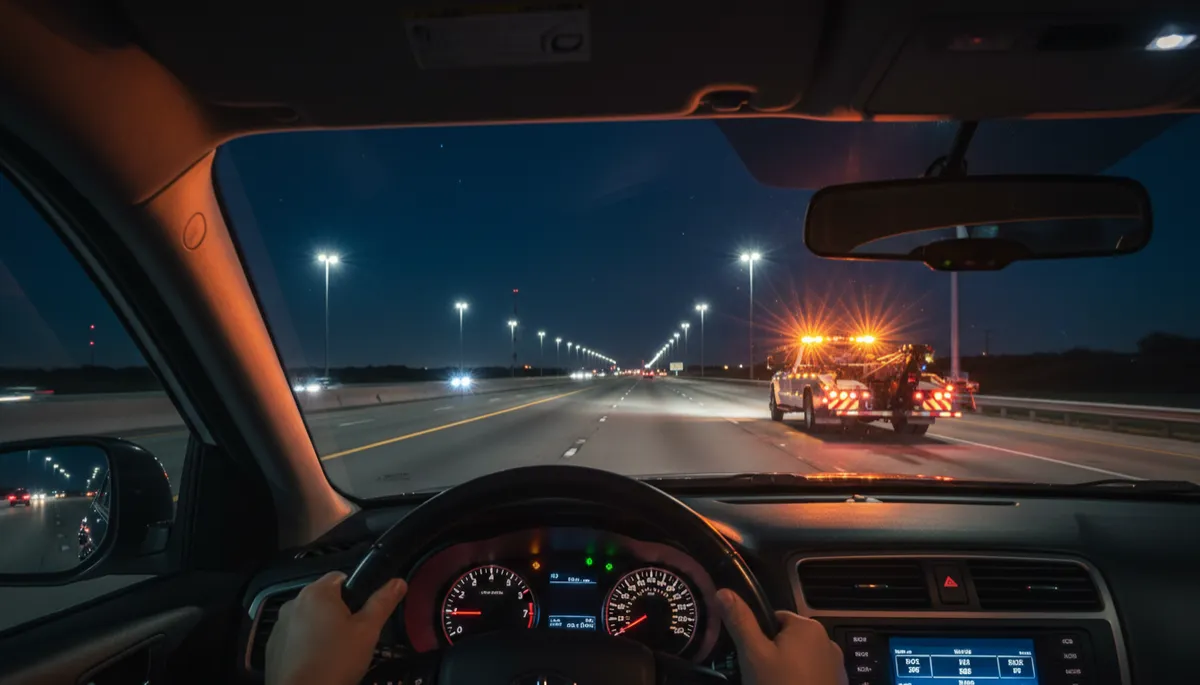
From the driver’s seat, a stopped tow truck appears quickly and leaves little reaction time.
What Tow Truck Operators Face on the Shoulder
Tow truck operators in North Texas work in conditions most drivers never fully see. When a call comes in, they respond in all weather — blazing summer heat, thunderstorms, winter cold snaps — and at all hours of the night. On scene, they may be:
- Crawling under a vehicle to attach chains or recovery straps
- Walking between their truck and the disabled car, often with their back to traffic
- Loading vehicles on inclines, curves, or narrow shoulders where there is almost no escape path
Even with high‑visibility vests, cones, and flashing amber lights, they are fundamentally working in an active traffic lane. Every car that refuses to move over or slow down pushes a wall of air and a real risk toward them. Honoring the Texas Move Over Law is not just about avoiding a ticket; it is about sending every operator home to their family at the end of a shift.
Practical Driving Tips for Passing a Tow Truck Safely
As a developer, I like clear logic and simple rules. You can think of your response to flashing roadside lights as a small decision tree. If we wrote it out in code, it might look like this:
def handle_move_over_law(posted_speed_mph: int,
                          can_change_lanes_safely: bool) -> str:
    if can_change_lanes_safely:
        return "Change lanes away from stopped vehicle."

    if posted_speed_mph <= 25:
        target_speed = 5
    else:
        target_speed = max(posted_speed_mph - 20, 0)

    return f"Stay in lane and slow to about {target_speed} mph."
Translating that into real‑world driving, here are practical steps you can apply on any DFW highway:
- Scan ahead for flashing lights. On I‑30 or I‑35W, you may see a glow long before you can identify the vehicle. As soon as you notice it, start planning your lane change or slowdown.
- Check mirrors and blind spots early. Do not wait until you are almost on top of the tow truck. Look, signal, and begin merging away from the shoulder side as soon as it is safe.
- Signal clearly and avoid sudden moves. A smooth lane change gives drivers behind you time to react. Abrupt swerves or panic braking can cause rear‑end crashes or cutoffs.
- If you cannot merge, ease off the accelerator early. Let your vehicle gradually slow to the required speed — roughly 20 mph below the posted limit — before you reach the tow truck, not as you pass it.
- Watch for people, not just vehicles. Look for operators walking around the scene, stranded drivers standing near the guardrail, or police officers directing traffic. Give them extra room and be ready to brake.
Two‑Lane Roads and Rural Highways Around DFW
Not every roadside emergency happens on I‑20 or I‑635. Around Arlington, Mansfield, Grand Prairie, and rural parts of Tarrant and Johnson Counties, you will encounter two‑lane roads where there is no extra lane to move into. The Move Over Act Texas still applies; you just handle it differently:
- Slow to a “safe speed.” Practically, that means well below the posted limit — often more than 20 mph under if the road is narrow or sight distance is short.
- Move as far left in your lane as safely possible. Hug the centerline without crossing into oncoming traffic or overcorrecting.
- Be prepared to stop. A tow operator or stranded driver may step into your lane unexpectedly, especially on curves or hills where they misjudge your distance.
On these roads, your judgment matters as much as the statute. If conditions are tight, it is better to slow significantly more than the minimum than to pass at a speed that feels unsafe.
Nighttime, Rain, and Low‑Visibility Conditions
Many roadside emergency DFW calls happen at night or in bad weather — exactly when visibility and traction are at their worst. Flashing amber lights can reflect off wet pavement and windshields, making it harder to judge distance and speed. Headlight glare from oncoming traffic on I‑30 or Loop 12 can hide pedestrians on the shoulder until you are almost next to them.
- Increase your following distance. Give yourself more time to see and react to brake lights ahead when others slow for a tow truck or police car.
- Slow earlier than you think you need to. Wet or oily pavement, especially after the first rain, can dramatically increase stopping distance.
- Avoid distractions completely. At night in the rain is the worst time to glance at your phone or infotainment screen. You need every bit of attention for tow truck safety and your own.
Bringing It Home for DFW Drivers
The Texas Move Over Law is straightforward: when you see flashing lights on the shoulder, you either move over a lane or slow down significantly. In the Metroplex, where traffic density and speed leave almost no margin for error, consistently following this rule is one of the simplest ways to improve highway safety DFW for everyone — tow operators, first responders, stranded families, and you.
If you ever find yourself stranded on I‑20, I‑30, SH‑360, or any road around Arlington, it helps to know that professional help is close by. Roadside Wrangler – 24/7 Towing Service provides towing and roadside assistance across the DFW area from its base at 3004 E Pioneer Pkwy, Arlington, TX 76010. Their team works around the clock — open 24 hours — to handle breakdowns, collisions, and other roadside emergencies safely and efficiently. You can reach them any time at (469) 212‑4712 or learn more at https://roadsidewranglertowing.com/. When you call for help and when you pass a scene on the highway, the same principle applies: give the people working on the shoulder the space and respect they need to do their job and get home safely.