Transmission Trouble in DFW: Drive It or Tow It?
Your car hesitates when you press the gas, the engine revs but the car barely moves, or the gear shift suddenly feels stuck. Now you are sitting in traffic on I-30 or I-20 asking one question: can I limp this thing home, or do I need a tow? For a transmission problem, the answer depends on what the car is doing, and guessing wrong can turn a repairable problem into a far more expensive one.
The short answer: if the car will not go into gear, slips so the engine races without pulling you forward, grinds or clunks when it shifts, smells burnt, or is leaking fluid, stop driving and call for a tow. If the shifting is only slightly rough, no warning light is on, and the car drives normally otherwise, you can usually make a careful trip to a repair shop. Everything below explains how to tell the difference and how the car should be towed once you decide.
What a Failing Transmission Feels Like
The transmission moves power from the engine to the wheels. When something inside it goes wrong, you rarely get a clear signal. You get symptoms, and most drivers recognize at least one of these:
- Slipping: the engine speed climbs but the car does not accelerate the way it should, or it seems to drop out of gear on its own.
- Delayed engagement: you shift from park into drive or reverse and the car takes a noticeable moment before it moves.
- Harsh or erratic shifts: a hard jolt between gears, or shifts that come at odd times.
- Grinding, whining, or clunking: noises that change as the car shifts or as speed changes.
- A burning smell: overheated transmission fluid has a sharp, burnt odor that is different from normal engine smells.
- A warning light: a transmission temperature light, a check engine light, or a car that drops into a limited "limp" mode and refuses to shift past a certain gear.
- Fluid on the ground: transmission fluid is often reddish or brown, and a puddle toward the middle or front of the car is worth taking seriously.
Drive It or Tow It? A Practical Guide
Every extra mile driven on a transmission that is slipping or grinding can damage internal parts that were still usable a mile earlier. Fluid that has leaked out cannot cool or lubricate anything, so a low-fluid transmission can overheat quickly, especially in DFW stop-and-go traffic during a Texas summer afternoon, when heat is already hard on the drivetrain.
Call for a tow when:
- The car will not shift into drive or reverse, or it is stuck in park or stuck in gear.
- The engine revs but the car barely moves or does not move at all.
- You hear grinding, loud clunking, or whining that gets worse as you drive.
- You smell burning or see smoke.
- Fluid is actively leaking.
- A warning light is flashing, or the car has dropped into limp mode on a highway.
A cautious drive to a shop may be reasonable when:
- The shifting is slightly rough but consistent and the car otherwise accelerates normally.
- No warning light is on and there is no leak or burning smell.
- The shop is close, and you can get there on surface streets without sustained high-speed driving.
When you are not sure, treat it as a tow. A tow is a known cost. A transmission that fails completely a few miles later, possibly in a live lane, is an unknown one.
If It Happens on a Busy Highway
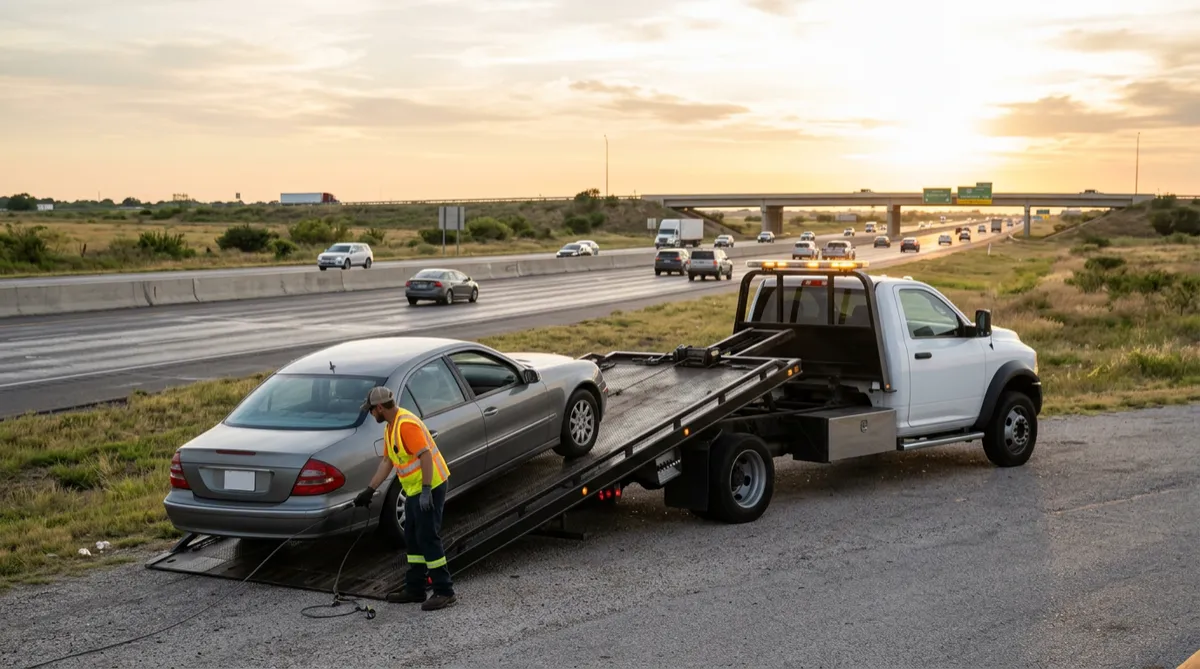
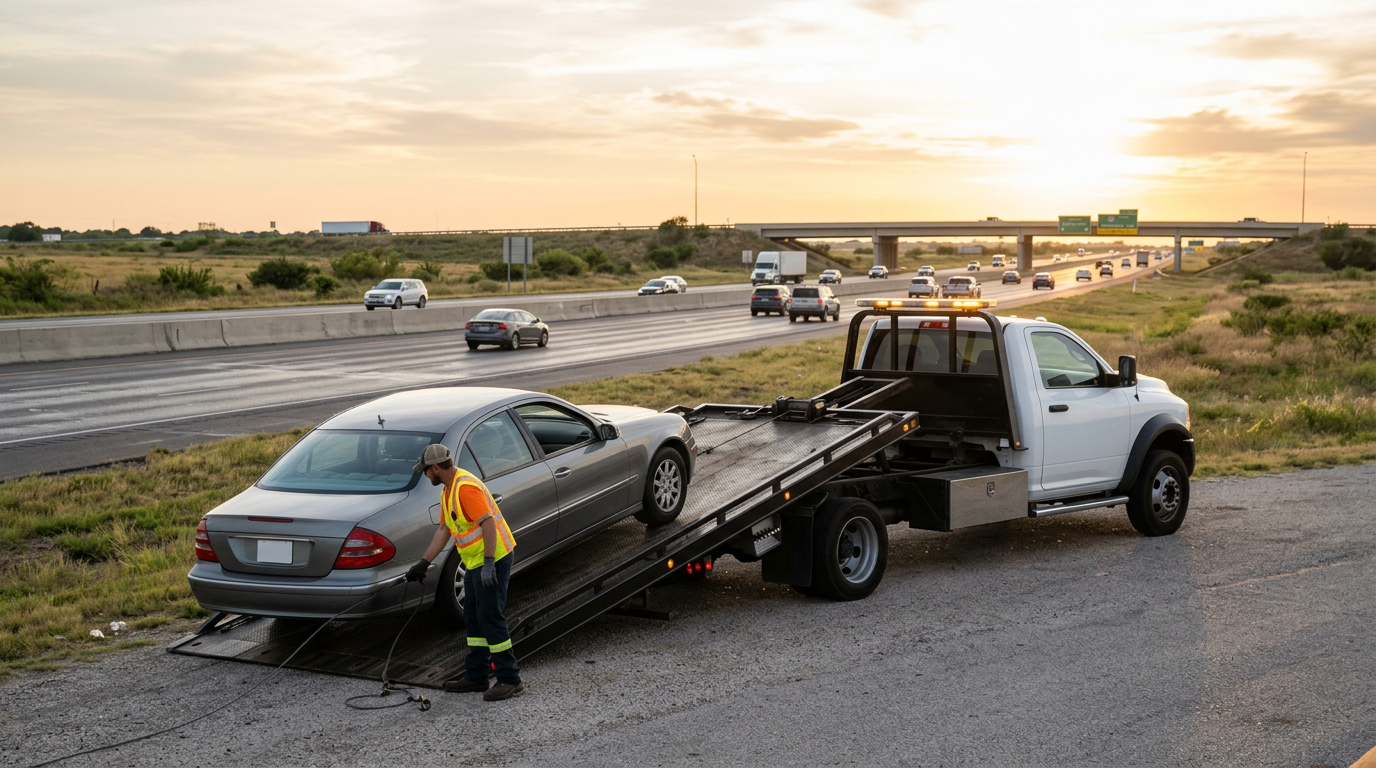
A transmission that quits at highway speed can leave you with less control and less warning than a flat tire. Ease off the gas, turn on your hazard lights, and steer toward the right shoulder as soon as it is safe. If the car drops into limp mode, it may still have enough power to get you out of the travel lane. Use it for that, not to keep driving.
Once you are stopped, stay safe before you diagnose anything. A DFW shoulder next to fast traffic is not a place to stand beside the car or pop the hood. If you can, stay inside with your seat belt on, or step out on the side away from traffic and wait well off the road, behind a guardrail if one is available. Checking transmission fluid is something to leave for a shop. Many newer vehicles have sealed transmissions with no dipstick at all, and an engine that has been running hot is a burn risk.
Why Transmission Problems Call for a Flatbed
This is the part many drivers do not know. When a car is towed with its drive wheels on the ground, those wheels turn the output side of the transmission while the engine is off. With the engine off, the transmission fluid pump is not running, so parts inside can spin without proper lubrication. On a healthy transmission and a short tow, that may be tolerable depending on the vehicle. On a transmission that is already damaged, low on fluid, or slipping, it can cause additional damage.
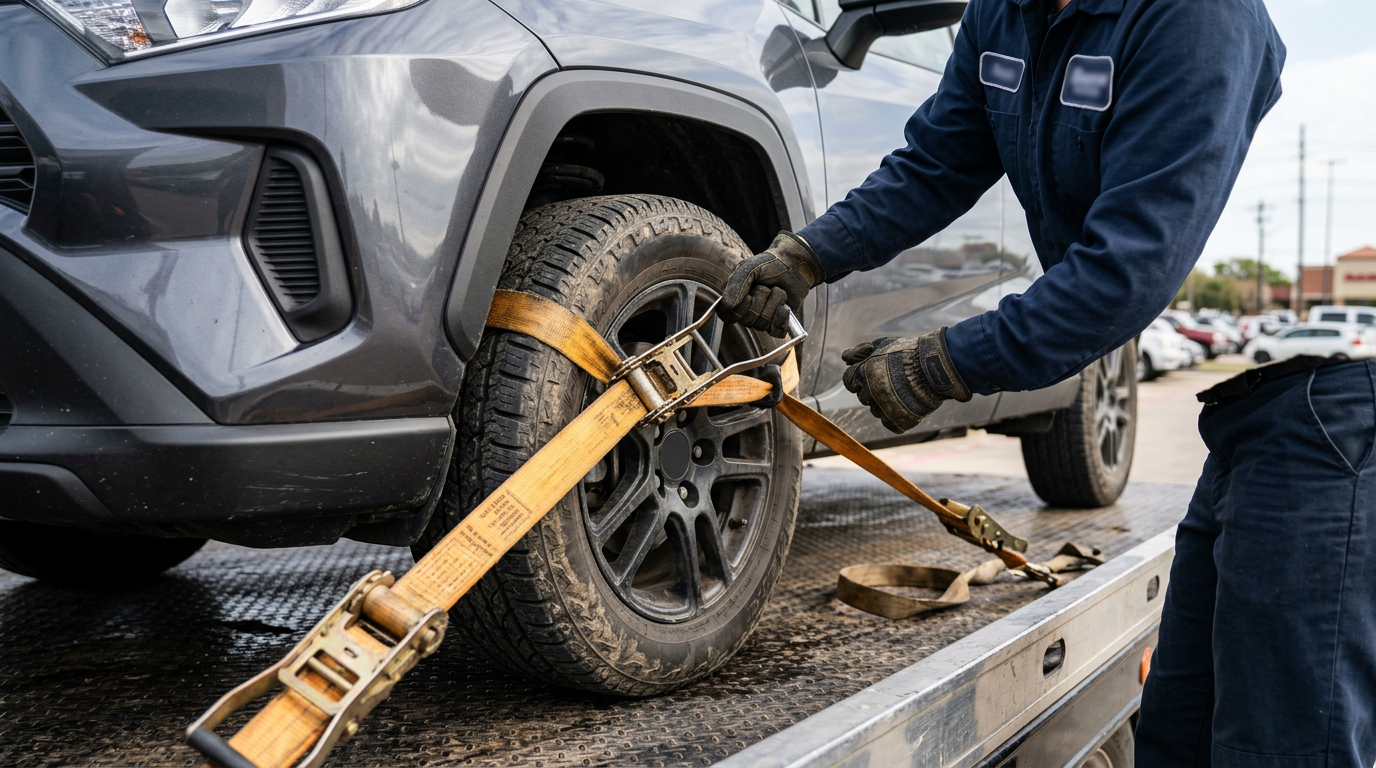
A flatbed avoids the question. The whole vehicle rides on the bed with its wheels off the road, so nothing inside the drivetrain is turning during the trip. For a car with a known transmission problem, that is generally the safest method, and it is often the only workable one:
- The car will not shift out of park: the parking mechanism is locking the drive wheels, so dragging it on those wheels risks damage.
- The car will not shift into neutral: a tow that relies on neutral is not an option.
- AWD and 4WD vehicles: these send power to all four wheels, so lifting only one end can still turn drivetrain parts. Most manufacturers call for all four wheels off the ground, which a flatbed provides.
- Front-wheel-drive and rear-wheel-drive cars: a wheel-lift tow may work for some vehicles when the right wheels are lifted, but it depends on the drivetrain and the condition of the transmission, which is exactly why you should tell the dispatcher what is going on.
Your owner's manual also spells out what the manufacturer allows for towing, and a professional operator should already know which method fits your vehicle.
What to Tell the Dispatcher
The more accurate your description, the better prepared the truck will be when it arrives. When you call, have this ready:
- Year, make, and model, and whether it is front-wheel, rear-wheel, AWD, or 4WD.
- Exactly what the car is doing: slipping, won't go into gear, stuck in park, grinding, leaking, warning light.
- Where you are, including the highway, direction of travel, nearest exit or mile marker, and which shoulder you are on.
- Whether the car sits low to the ground, has aftermarket changes, or has any damage that could affect loading.
- Where it needs to go: a shop, a dealership, or your home.
Ask for a quote up front, including any extra charge for distance, and ask what method will be used. A reputable company can give you straight answers on both.
Where to Take the Car
Before the truck arrives, decide on the destination, because it saves time and avoids a second move. A transmission shop or a dealership service department is usually the right place. Keep in mind that many repair shops are closed overnight or on weekends. If your breakdown happens late at night, ask whether the car can be taken to your home and held there, or to a secure lot, until the shop opens.
Ways to Lower the Odds of a Surprise
You cannot prevent every transmission failure, but a few habits help you catch trouble early:
- Follow the maintenance schedule in your owner's manual for transmission fluid service. Intervals vary widely between vehicles.
- Do not ignore small changes. A new hesitation or a faint burning smell is cheaper to check early.
The Bottom Line
A transmission problem is one of the few breakdowns where how you move the car matters as much as when you call. If it will not shift, slips, grinds, smells burnt, or leaks, do not keep driving it, and ask for a flatbed so the drivetrain is not asked to turn while it is damaged. If the symptoms are mild, a short and careful trip to a shop is reasonable, but a tow is the safer call whenever you are unsure.
If your car stops shifting somewhere in Arlington, Fort Worth, Dallas, or anywhere in between, Roadside Wrangler is ready to help around the clock. Tell the dispatcher what the car is doing, and they can send the right truck and get your vehicle moving safely to the shop or home of your choice, day or night.
Roadside Wrangler – 24/7 Towing Service
3004 E Pioneer Pkwy, Arlington, TX 76010
Phone: (469) 212-4712
Website: https://roadsidewranglertowing.com/
Open 24 hours